Substituted Cyclohexanes
Ring Strain and why Cyclohexane Puckers
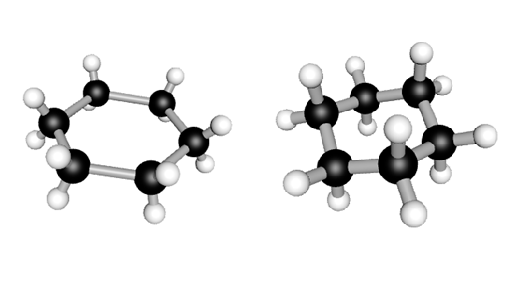
Cyclohexane (C₆H₁₂) is a fully saturated carbocycle. If it were flat (left-hand image), its internal angles would be 120°, far from the ideal tetrahedral angle of sp3 carbon at 109.5°, producing angle strain. A flat ring would also force every adjacent C–H bond to eclipse its neighbour, adding torsional strain.
Cyclohexane avoids both by puckering out of plane. The chair conformation (right-hand image) results: every bond angle sits at ~109.5° and every adjacent C–H bond is perfectly staggered, so the ring is essentially strain-free. This is why chair cyclohexane is the reference point for nearly all ring stereochemistry.
The Chair Conformation & Ring Flip
The chair isn't rigid - it can flip. Moving carbon atoms carries the molecule through a higher-energy boat conformation, which suffers both torsional strain and a steric “flagpole” clash between the groups attached to the two carbons that point the same direction, into a new chair.
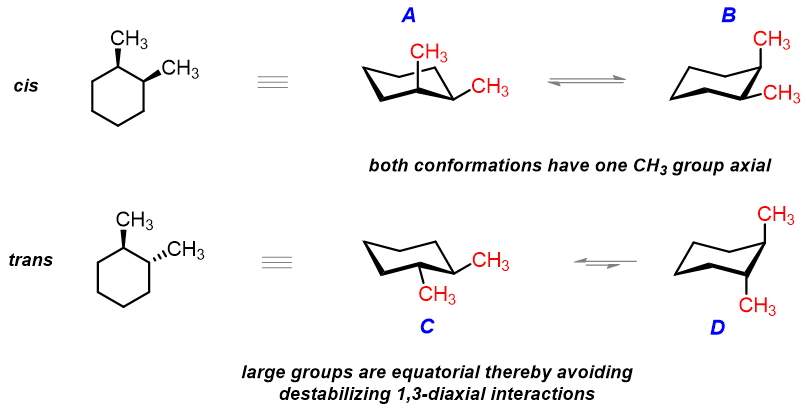
A ring flip interconverts the two chairs continuously at room temperature. Every position that was pointing up now points down, and importantly: every substituent that was axial becomes equatorial, and every equatorial substituent becomes axial. Cis/trans relationships between substituents never change, only their axial/equatorial character.
Axial vs. Equatorial Positions
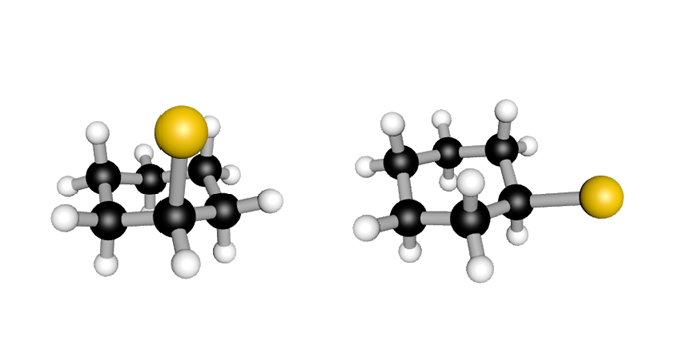
Every carbon in the chair has one axial bond (pointing straight up or down, parallel to the ring's imaginary vertical axis) and one equatorial bond (pointing outward, away from the ring).
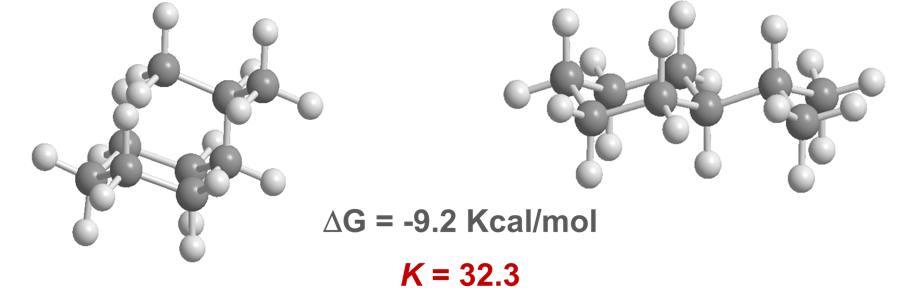
Axial substituents on carbons 1, 3, and 5 all point in the same direction and sit close to one another, and this is the source of 1,3-diaxial interactions (see the left-hand molecule below) the main steric penalty for putting a larger group axial. Equatorial substituents point outward into open space and avoid this clash almost entirely.
Monosubstituted Cyclohexanes & A-Values
For a monosubstituted cyclohexane, the two ring-flip chairs are not equal in energy: the conformer with the substituent equatorial avoids 1,3-diaxial strain and is favoured. The bigger the group, the stronger that preference.
The A-value quantifies this: the free-energy difference (kcal/mol) between the axial and equatorial forms. A larger A-value means a stronger equatorial preference — and a more sterically demanding group.
A bulky tert-butyl group has such a large A-value that a cyclohexane ring bearing it exists almost exclusively (>99.9%) in the conformer with the group equatorial.
Disubstituted Cyclohexanes: cis/trans & 1,2 / 1,3 / 1,4
With two substituents, both their relative positions on the ring (1,2-/1,3-/1,4-) and their relative stereochemistry (cis/trans) determine whether they can both be equatorial at once.
Steric Strain: 1,3-Diaxial Interactions
The total energy penalty for placing a group axial is the sum of its interactions with the two axial hydrogens (or groups) at the 3- and 5-positions, the 1,3-diaxial interactions. Each is sterically similar to a gauche interaction in an open chain, but a chair has two of them per axial substituent, which is why A-values run roughly twice the size of a single gauche interactive penalty.
This single steric effect explains most of cyclohexane conformational chemistry: why bulky groups sit equatorial, why some disubstituted isomers are far more stable than others, and why reactions that depend on ring geometry (eliminations, oxidations, glycoside formation) are so sensitive to substitution pattern.